German · Wechselpräpositionen · A2–B1
Two-way prepositions: dative or accusative?
Nine little words that point two ways. The trick isn't memorizing them, it's asking one question: am I moving, or am I already there?
Nine little words that point two ways. The trick isn't memorizing them, it's asking one question: am I moving, or am I already there?
Every two-way preposition can take either case. Which one depends entirely on meaning, so ask yourself which question the sentence answers.
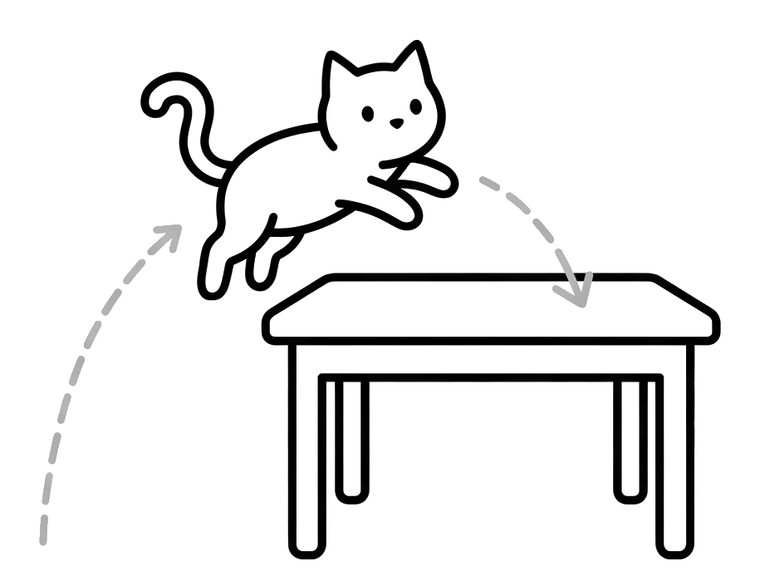
Watch the arrow. When the cat is heading onto the table, that's motion, accusative. Once it's just sitting there, that's location, dative. The preposition auf never changed. The meaning did.

German pairs its verbs: one for putting something somewhere, one for it being there. Spot the verb and the case follows.
The pairs give it away: stellen / stehen, legen / liegen, setzen / sitzen. The first puts it there; the second says it is there.
You've decided the case, now you have to say it. It lands on the article, so these endings are the thing to get automatic.
Onto the table, then on the table. One letter of difference. That's the whole game.
| Gender | Akk. | Dativ |
|---|---|---|
| Masculine | den Tisch | dem Tisch |
| Neuter | das Regal | dem Regal |
| Feminine | die Wand | der Wand |
| Plural | die Stühle | den Stühlen |

The preposition and its article are highlighted. Before you tap, ask Wohin or Wo, then reveal the answer and why it goes that way.
Tap any sentence to reveal · tap the star to save
These are the ones that swing both ways. Every other German preposition is fixed to a single case, only these nine make you choose.
Nine: an, auf, hinter, in, neben, über, unter, vor, and zwischen. Each can take the dative or the accusative depending on whether you're describing location or direction.
Ask “Wohin?” or “Wo?”. If the sentence answers “Wohin?” (where to, motion toward a destination) use the accusative. If it answers “Wo?” (where, a fixed location) use the dative.
It helps. Motion verbs like stellen, legen, and setzen usually signal the accusative, while position verbs like stehen, liegen, and sitzen usually signal the dative. But it's really the meaning, direction vs location, that decides.
Yes. GrammarWerk is free, teaches German, Spanish, English, and French, and has no tracking. You can practice on Google Play or at app.grammarwerk.com.
Get 30 fresh sentences on this exact topic, pinned to your level, each one highlighting the target structure.